Anthropic Releases Claude Fable 5.2: Robotics and Mathematics
Anthropic has introduced Claude Fable 5.2 and Claude Mythos 5.2, new versions of its models designed for complex technical tasks. The company reports improvements in coding, reasoning, and visual understanding. In preliminary tests, the models helped solve two open problems in black hole physics and formalize the proof of Fermat’s Last Theorem. Here are the other key results.
Faster and More Affordable
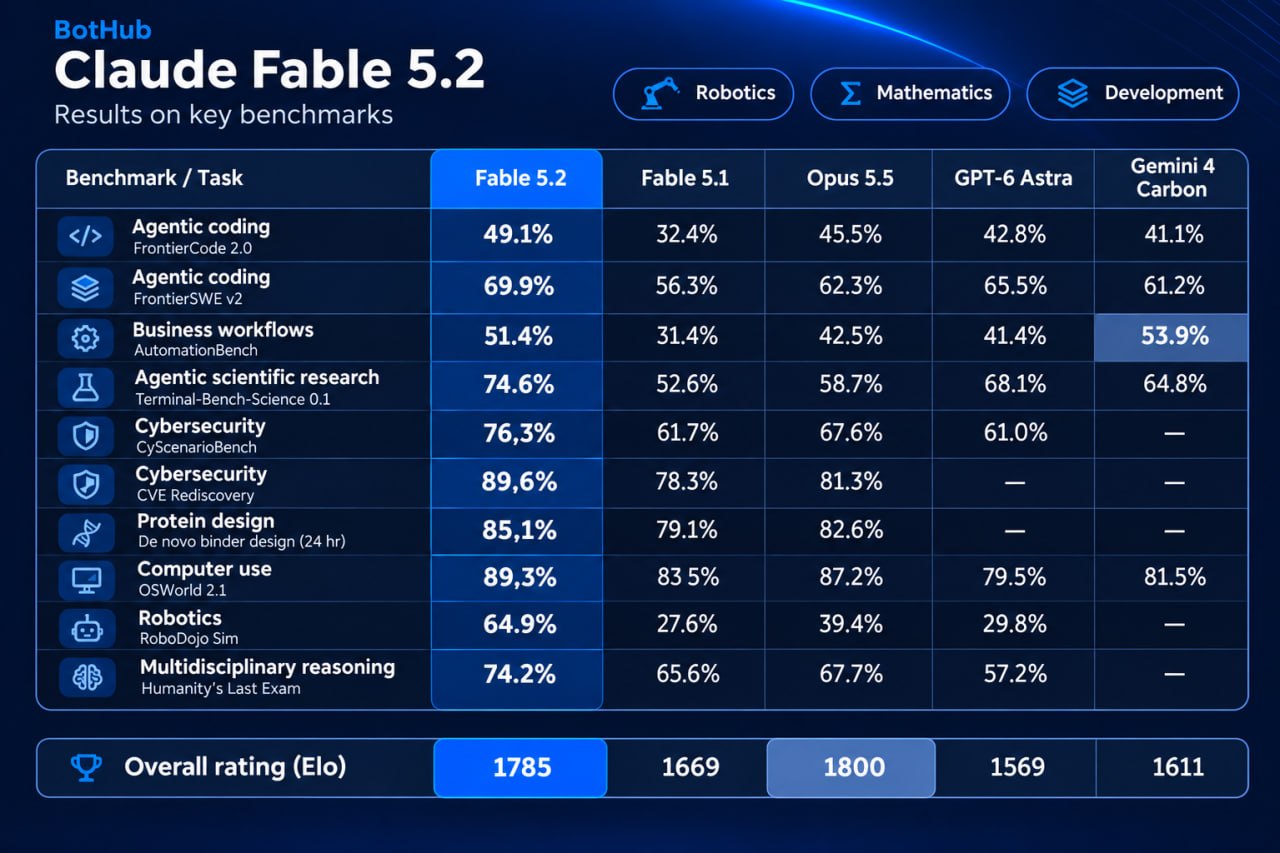
Fable 5.2 generates responses up to 30% faster than its predecessor. API pricing has decreased by 20%, from 10/50 to $8 per million input tokens and $40 per million output tokens.A fast mode is also available, increasing token generation speed by up to 2.5x at twice the standard price: 16/80 per million tokens.In benchmarks, Fable 5.2 outperforms Opus 5.5 across nearly all tested categories. For example, on FrontierCode 2.0, Fable 5.2 with High effort scored 45.3%, nearly matching Opus 5.5 with Max effort (45.5%).At the same time, the cost of completing the task was approximately half as high.With Xhigh effort, Fable 5.2 achieved 49.1%, the highest score among released models evaluated by Anthropic. However, it does not outperform every competitor across all benchmarks. On AutomationBench, for example, Fable 5.2 scored 51.4%, compared to Gemini 4 Carbon’s 53.9%.
Robot Control
Fable 5.2 features significant improvements in controlling physical robots. In demonstrations, robots controlled by the model assemble a cube, unscrew a bottle cap, and draw a picture of a robot. The model can also handle tasks it was not specifically trained to perform.On RoboDojo Sim, Fable 5.2 scored 64.9%, compared to 29.8% for GPT-6 Astra, 39.4% for Opus 5.5, and 27.6% for the previous Fable 5.1.
Formalizing Fermat’s Last Theorem in 30 Hours
A team of 1,000 Fable 5.2 agents fully formalized the proof of Fermat’s Last Theorem in Lean in just 30 hours, with minimal human involvement.To clarify, this was not a new mathematical discovery. The model translated an existing proof into a formal representation that a computer can verify step by step.Anthropic’s previous attempt, conducted using an earlier research version of Claude, took 11 days and required a specially prepared environment and assistance from a researcher.In the new experiment, the agents independently coordinated their work, operated with minimal guidance, and used a list of intermediate mathematical statements to track their progress.This time, the process required only one-third of the action tokens used in the initial formalization, while the resulting proof was seven times shorter.
Fable 5.2 Built Its Own Operating System
In another experiment, an Anthropic engineer tasked the model with developing an operating system prototype from scratch. The model coordinated more than 1,000 subagents that continuously wrote, tested, and reviewed code over eight days.The result was an operating system capable of booting on a laptop. It includes its own kernel, disk, keyboard, and network drivers, persistent file storage, a graphical windowing interface, a login screen, an installer, and integrated Claude functionality.
Solving Two Open Problems in Black Hole Physics
Fable 5.2 solved two open problems in theoretical physics involving black holes and efforts to reconcile general relativity with quantum mechanics.In the first problem, the model completed a calculation that physicists had outlined back in 2003 but had been unable to finish due to its complexity. The question was whether a sharp phase transition persists during black hole formation in very small universes, where classical descriptions of gravity no longer apply.The model determined that the transition remains sharp.In the second problem, Fable 5.2 identified the precise limits of a method that physicists had used for more than 15 years to rule out candidate theories of quantum gravity in a simplified model of the universe.The results have been published as preprints. One of the papers notes that a physicist verified the findings against several known special cases, while an independent calculation performed by another version of Claude produced the same result.
Mythos 5.2 and Protein Capsid Modeling
Another notable result comes from biology. Mythos 5.2 developed a new method for predicting the structure of capsids, the protein shells of adeno-associated viruses. These viruses are used as vectors to deliver genetic material in gene therapy.The challenge is that a capsid consists of dozens of protein chains. Models such as AlphaFold can predict the structures of individual proteins, but assembling them into a complete, complex capsid is considerably more difficult.Mythos 5.2 combined two open-source protein structure prediction tools, running them on overlapping groups of protein chains and then using the known symmetry of the capsid to reconstruct its overall structure.In tests, the method successfully modeled 28 of the 34 naturally occurring and engineered capsids evaluated.
Availability
Fable 5.2 is already available on BotHub without a VPN, as well as through Anthropic’s platforms, AWS, Google Cloud, and Microsoft Azure.Mythos 5.2 is intended for vetted organizations working in cybersecurity and biomedical research.
Anthropic Releases Claude Fable 5.2: Robotics and Mathematics :: BotHub